
Stories about the ways water moves through natural and human-constructed landscapes... what we can learn from it and how we can use old and new ideas to understand, appreciate, and sustainably use this resource.
Tuesday, August 23, 2011
Technology Side Project: Creating an Invasive Species Computer Game
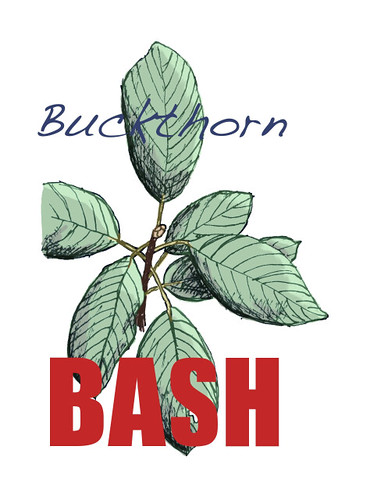
Lately I've been working on a little side project, which involves figuring out how to make computer games with the game software GameMaker. The game I've come up with (which is in its early stages!) is called Buckthorn Bash.


Monday, August 22, 2011
Flash Flood Tragedy in Pittsburgh - Let's Keep it from Happening Again
Pittsburgh was faced with a tragedy last week when extreme downpours caused a flash flood that killed four people.
A torrential thunderstorm dumped two inches of rain in an hour, on top of already saturated ground. This caused a massive sewage-stormwater overflow that suddenly swamped Washington Boulevard, leading to the tragedy that claimed these four lives, including two small children.
I found this article about lessons learned from the flood. The point that life is precious and tenuous is a well-made point. But why not look beyond that? Why not look at the causes of this disaster and try to keep it from happening again? Warning systems and closures are on the right track, but may not be enough.
A quick glance at Google Earth shows why Washington Street is prone to flooding:
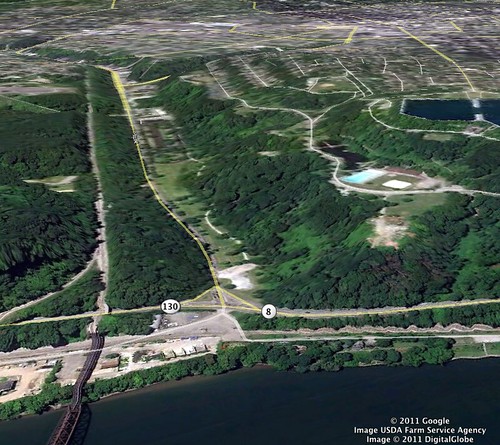
It's in a hollow, just like Panther Hollow, Junction Hollow, and the many other hollows of Pittsburgh. It's been a hollow since before the city was built. And, under the earth and concrete, in a sewer line, is the buried, modified path of what was once called Negley's Run.
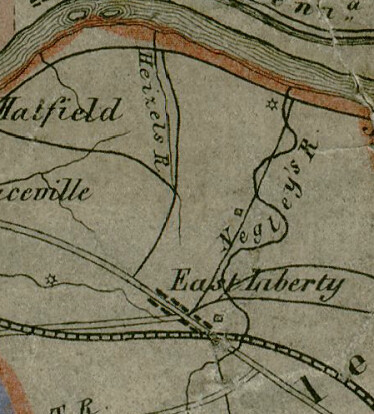
(The above image comes from an 1850 map available online from the Darlington Digital Library, an amazing resource.)
When a waterway is put underground, it is out of sight and often out of mind, but it doesn't stop being a waterway. Negley's run has a rather large watershed, one that still captures massive amounts of water during summer downpours. In fact, runoff is faster now than it was before the city was built. Impervious substrates rush water into the drains, where it is funneled through pipes. Furthermore, without being able to easily see what is happening in the pipes, it is difficult to know if there are blockages in the flow, or to see water quickly rising.
Sewage-stormwater overflows happen often in Pittsburgh, but usually 'only' dump sewage into the rivers. During my project I did learn that overflows like this one do sometimes happen in the Junction Hollow neighborhood, where they fill the basements of unfortunate residents with sewer water. Overflows happen into Nine Mile Run at Frick Park as well.
I don't know if rain gardens, impervious substrates, additional trees, rain barrels, and daylighted streams could have stopped this flood. I do know that these measures have been proven to SLOW the movement of floodwaters (after all, that is what inspired the title of this blog). Water rose FAST during this flood - acting more like a flash flood in the Desert Southwest than a flood typical of Pennsylvania. If we could have slowed this flood down just a few minutes, it might have been enough to prevent these tragic deaths.
Watershed health isn't 'just' an environmental issue. Floods kill people each year, and ruin the homes and businesses of many more. As weather appears to be becoming more extreme, perhaps due to climate change, and as we degrade watersheds more and more, tragedies like this are going to become more and more common if we don't act to offset the damage. No single person's sewer-connected drainspout can be blamed for this tragedy, but if each drainspout in the watershed was disconnected, maybe these deaths could have been avoided.
A torrential thunderstorm dumped two inches of rain in an hour, on top of already saturated ground. This caused a massive sewage-stormwater overflow that suddenly swamped Washington Boulevard, leading to the tragedy that claimed these four lives, including two small children.
I found this article about lessons learned from the flood. The point that life is precious and tenuous is a well-made point. But why not look beyond that? Why not look at the causes of this disaster and try to keep it from happening again? Warning systems and closures are on the right track, but may not be enough.
A quick glance at Google Earth shows why Washington Street is prone to flooding:
It's in a hollow, just like Panther Hollow, Junction Hollow, and the many other hollows of Pittsburgh. It's been a hollow since before the city was built. And, under the earth and concrete, in a sewer line, is the buried, modified path of what was once called Negley's Run.
(The above image comes from an 1850 map available online from the Darlington Digital Library, an amazing resource.)
When a waterway is put underground, it is out of sight and often out of mind, but it doesn't stop being a waterway. Negley's run has a rather large watershed, one that still captures massive amounts of water during summer downpours. In fact, runoff is faster now than it was before the city was built. Impervious substrates rush water into the drains, where it is funneled through pipes. Furthermore, without being able to easily see what is happening in the pipes, it is difficult to know if there are blockages in the flow, or to see water quickly rising.
Sewage-stormwater overflows happen often in Pittsburgh, but usually 'only' dump sewage into the rivers. During my project I did learn that overflows like this one do sometimes happen in the Junction Hollow neighborhood, where they fill the basements of unfortunate residents with sewer water. Overflows happen into Nine Mile Run at Frick Park as well.
I don't know if rain gardens, impervious substrates, additional trees, rain barrels, and daylighted streams could have stopped this flood. I do know that these measures have been proven to SLOW the movement of floodwaters (after all, that is what inspired the title of this blog). Water rose FAST during this flood - acting more like a flash flood in the Desert Southwest than a flood typical of Pennsylvania. If we could have slowed this flood down just a few minutes, it might have been enough to prevent these tragic deaths.
Watershed health isn't 'just' an environmental issue. Floods kill people each year, and ruin the homes and businesses of many more. As weather appears to be becoming more extreme, perhaps due to climate change, and as we degrade watersheds more and more, tragedies like this are going to become more and more common if we don't act to offset the damage. No single person's sewer-connected drainspout can be blamed for this tragedy, but if each drainspout in the watershed was disconnected, maybe these deaths could have been avoided.
Tuesday, August 16, 2011
Flooding and Hail along the Middlebury River
Just a couple of weeks ago I had a blog post about how dry Vermont was. It's amazing how quickly things change.
The dry conditions continued for a while after I made that post, but last week it started raining. The rain started with an overnight drenching on the night of the 9th, amounting to an inch of rain around the Middlebury River watershed. On the 11th much of Vermont was relatively dry, with only a few scattered thunderstorms. However, a slow-moving severe storm formed near Middlebury and moved right up the Middlebury River, through East Middlebury and Ripton. The storm dumped an additional 2 to 3 inches of rain in the watershed, in about an hour!
In two days, the river went from looking like this:
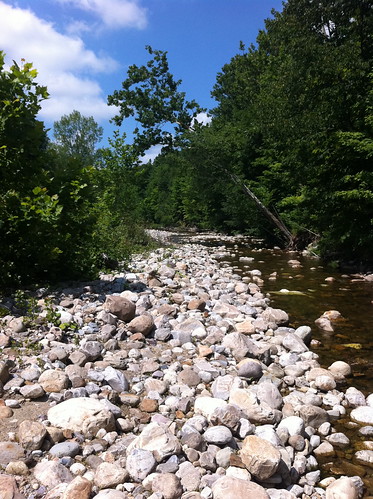
To looking like this:
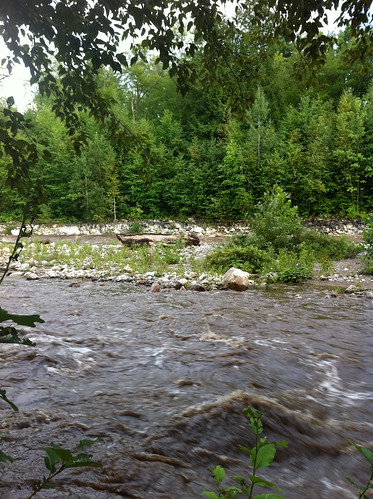
Water levels rose very close to the level we experienced during the heavy spring flood last May. And that's not all...
The dry conditions continued for a while after I made that post, but last week it started raining. The rain started with an overnight drenching on the night of the 9th, amounting to an inch of rain around the Middlebury River watershed. On the 11th much of Vermont was relatively dry, with only a few scattered thunderstorms. However, a slow-moving severe storm formed near Middlebury and moved right up the Middlebury River, through East Middlebury and Ripton. The storm dumped an additional 2 to 3 inches of rain in the watershed, in about an hour!
In two days, the river went from looking like this:
To looking like this:
Water levels rose very close to the level we experienced during the heavy spring flood last May. And that's not all...
Wednesday, August 10, 2011
Rainwater Pots in Thailand
I recently came across some photos of huge pots that are used in Thailand to collect rainwater from rooftops for use. These pictures were posted by John Hawker of Sat-Ed, a group that works to bring Internet access, and thus access to global information and education, to rural areas of Southeast Asia.

Thursday, August 4, 2011
Vermont Summer Dry Spell
It's hard to believe after the soakings of this spring, but Vermont is in the midst of a summer dry spell.
This isn't an extreme drought of the sort that Texas is experiencing. It's quite normal for Vermont to have several weeks of mostly dry weather in midsummer. As is often the case, there have been at least a few thunderstorms in Vermont each afternoon, but they have been small and fast-moving.
This dry spell isn't phasing the lush green growth in meadows and the forest understory that grew after this spring's rain. It is having an effect on the Middlebury River, though. With a steep, relatively small watershed, the Middlebury River is very sensitive to weather events in the short term. In fact, it reminds me a bit of the washes and canyons in southern California, with one key difference: even during dry periods, the Middlebury River is always flowing. Most rivers and streams in southern California are dry this time of year, especially in areas with wide, cobbly or sandy riverbeds, like the part of the Middlebury River I most frequently visit.
Here's one part of the river, as it looked about a half hour ago:
Here is how that same area looked during the May floods:
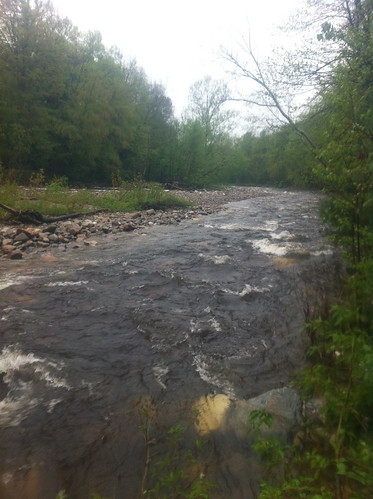
The view isn't from the exact same place, but note the leaning sycamore in both pictures. Note that this is also not the entire flow of the river, as this area has more than one river channel (typical of rivers that are full of cobbles and have a medium gradient). Even still, it really shows how the water level has changed.
The picture also demonstrates how amazingly fast cottonwoods and sycamores grow. Those large saplings to the left are the same trees as the little seedlings in the first picture! When the land you are growing on washes away in floods every few years, you have to mature and set seed fast!
More pictures below:
This isn't an extreme drought of the sort that Texas is experiencing. It's quite normal for Vermont to have several weeks of mostly dry weather in midsummer. As is often the case, there have been at least a few thunderstorms in Vermont each afternoon, but they have been small and fast-moving.
This dry spell isn't phasing the lush green growth in meadows and the forest understory that grew after this spring's rain. It is having an effect on the Middlebury River, though. With a steep, relatively small watershed, the Middlebury River is very sensitive to weather events in the short term. In fact, it reminds me a bit of the washes and canyons in southern California, with one key difference: even during dry periods, the Middlebury River is always flowing. Most rivers and streams in southern California are dry this time of year, especially in areas with wide, cobbly or sandy riverbeds, like the part of the Middlebury River I most frequently visit.
Here's one part of the river, as it looked about a half hour ago:
Here is how that same area looked during the May floods:
The view isn't from the exact same place, but note the leaning sycamore in both pictures. Note that this is also not the entire flow of the river, as this area has more than one river channel (typical of rivers that are full of cobbles and have a medium gradient). Even still, it really shows how the water level has changed.
The picture also demonstrates how amazingly fast cottonwoods and sycamores grow. Those large saplings to the left are the same trees as the little seedlings in the first picture! When the land you are growing on washes away in floods every few years, you have to mature and set seed fast!
More pictures below:
Saturday, July 30, 2011
Summer Update: Pittsburgh, Vermont, Southern California.
I haven't been back to Panther Hollow in Pittsburgh since winter, but the habitat restoration work in Schenley Park and the Junction Hollow Watershed are really taking off. Yesterday the Pittsburgh Parks Conservancy blog had a post by Krissy Hopkins, who is doing research on restoration in Panther Hollow. The post really brought me back to last year when I spent many hot, muggy days exploring the hollow and the larger Junction Hollow watershed that Panther Hollow is a part of. I wonder how much has changed in the last six months, and how the rain gardens I helped install in East Liberty are doing.
Meanwhile, in Vermont, the weather has done a 180 degree turn from what it was doing this spring. (No, it has not reached 180 degrees, though it felt like it for one week.) Instead of flooding, the weather has actually been rather dry. As that article points out, the summer rain has been very spotty and localized this year (as it often is). As it happens, the Middlebury area has been wetter than most areas, as we've been 'lucky' with the thunderstorms and rain. In fact, yesterday's rain seemed to target southern Addison County specifically! Nevertheless, it has been dry as a whole, and the rivers are low. Nothing like what they are seeing in Texas, and I suspect by the time fall comes around it will be wet again. Still, it is interesting how quickly conditions can change.
The forecast in Vermont is much the same for the next week: warm and mostly dry, but with a few scattered thunderstorms each afternoon.
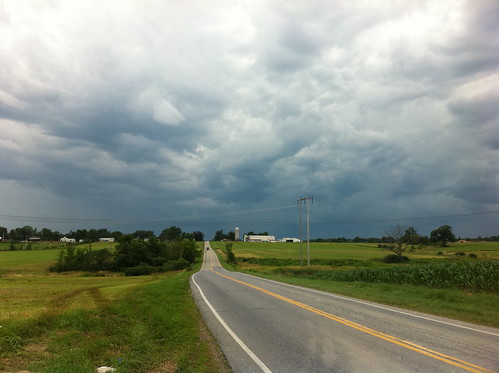
Above: a storm approaches the Middlebury Airport. The Middlebury area has been wetter than much of Vermont lately, probably just due to chance.
Southern California is expecting an easterly wave from the Southwest Monsoon today. As is often the case, thunderstorms are likely in the San Gabriel and San Bernardino Mountains. With this wave, however, there is also a chance that some of these thunderstorms will move out of the mountains towards the coast, bringing some rain and lightning to areas like Los Angeles or Ventura. Summer thunderstorms in these areas are quite rare - some years one or two storms make it to the coast in late July or August, but in many years there is no summer rain at all. If it does rain, enjoy the brief break from the dry season.
Meanwhile, in Vermont, the weather has done a 180 degree turn from what it was doing this spring. (No, it has not reached 180 degrees, though it felt like it for one week.) Instead of flooding, the weather has actually been rather dry. As that article points out, the summer rain has been very spotty and localized this year (as it often is). As it happens, the Middlebury area has been wetter than most areas, as we've been 'lucky' with the thunderstorms and rain. In fact, yesterday's rain seemed to target southern Addison County specifically! Nevertheless, it has been dry as a whole, and the rivers are low. Nothing like what they are seeing in Texas, and I suspect by the time fall comes around it will be wet again. Still, it is interesting how quickly conditions can change.
The forecast in Vermont is much the same for the next week: warm and mostly dry, but with a few scattered thunderstorms each afternoon.
Above: a storm approaches the Middlebury Airport. The Middlebury area has been wetter than much of Vermont lately, probably just due to chance.
Southern California is expecting an easterly wave from the Southwest Monsoon today. As is often the case, thunderstorms are likely in the San Gabriel and San Bernardino Mountains. With this wave, however, there is also a chance that some of these thunderstorms will move out of the mountains towards the coast, bringing some rain and lightning to areas like Los Angeles or Ventura. Summer thunderstorms in these areas are quite rare - some years one or two storms make it to the coast in late July or August, but in many years there is no summer rain at all. If it does rain, enjoy the brief break from the dry season.
Friday, July 29, 2011
Clean Water Should Not Be a Partisan Issue (just one political post)
I have my own political opinions, and enjoy a good debate as much as anyone. Yet, I've tried to keep politics out of this blog. Politics in the United States are more and more divisive by the day, and yet clean water and livable conditions are important to anyone and really are not a partisan issue.
Or, at least, they shouldn't be. I came across this story on the NPR website today about a Republican mayor in a conservative state who has worked to daylight a stream, creating an open space that has coincided with an economic boom in aptly-named Greenville, South Carolina.
I'll admit that I tend liberal on most issues, but I think it is important to give credit where credit is due. Conservatives, in particular conservative hunters and fishermen and people in rural areas, have been a tremendous part of the conservation movement, and in fact were the people who got the movement started. The people I know who consider themselves conservative care about water and open space just as much as I do. In fact, conservation is at its root a 'conservative' value. These days, though, it is usually perceived as a 'liberal' value. Really, it should be both. We all drink the same water, and no one wants poop, carcinogens, or heavy metals in their drinking water. Everyone likes a cool, clean river or lake to swim in or dip their feet in, without fear of getting sick. No one wants to live in squalor or misery.
So why are some Republican representatives trying to gut legislation that protects us from filthy water? The root of the issue seems to be that many believe that federal regulation is ineffective or corrupt, and that state, local, or private forces (corporations???) should keep our water clean instead. Certainly this is worth talking about, but talking about this isn't what is happening. If you are fighting a fire and your hose has holes in it, you don't turn off the hose and walk it away. You fix the hose, or you throw it away and hook up a new one. I urge any conservative readers of this blog to ask their representatives to propose SOLUTIONS to replace federal legislation, if they feel that the federal legislation doesn't work, rather than getting rid of the laws without a replacement. It is unacceptable for politicians to be sneaking legislation into an important economic bill, without dialog about these issues. During my time in Pittsburgh I learned about when the Monongahela River was steaming over 100 degrees in winter and full of every pollutant imaginable. I find it hard to believe anyone wants to go back to that. If we get rid of our current laws without setting something else up instead, we can expect to find that our rivers are lighting on fire again.
It has been said that the environmental movement has become lost, that the biggest environmental mistake of the last 30 years was removing humans from the equation. Perhaps we did spend too much effort on creating 'wilderness' areas 'free of human impact', rather than creating sustainable working landscapes and fostering a reconnection between people and the other elements of ecosystems. I think it was a necessary and reasonable reaction to the 19th and 20th centuries, but the old environmental movement may need a major overhaul. I also think it is time for something new. The new conservation movement needs to be non-partisan, needs to be realistic, and needs to be based on the things that are important to everyone, regardless of our other beliefs.
Thankfully, I am not the only one who feels this way. There are a lot of people trying to find good solutions as we speak. As we face possible and ongoing economic and ecological collapses on a variety of scales, we can't afford to squabble any more. We need to get things done. At our root, our species is defined by our use (and perhaps overuse) of tools. Our tools got us into this mess, and now is no time to throw them away. We need to use every tool we have at our disposal, from smartphones, satellites, and space research to our oldest, deepest spiritual and religious beliefs... and most important of all, our brains.
Hopefully, by my next post I'll be done talking about politics on this blog and will be back to talking about weather or the river. And, hopefully by then, we'll have a few more solutions and ideas to work with. Maybe you have one of them! Feel free to post your thoughts here - all civil comments are welcome.
Saturday, July 23, 2011
Summer 2011 Sketchbook, Part 1
Most of these are not water-related but I thought it would still be fun to post them. Sorry about the ugly photos, I don't have access to a scanner anymore.
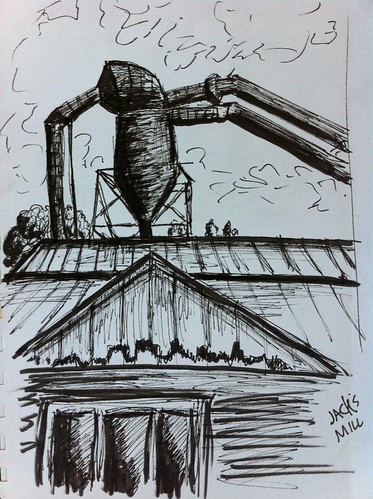
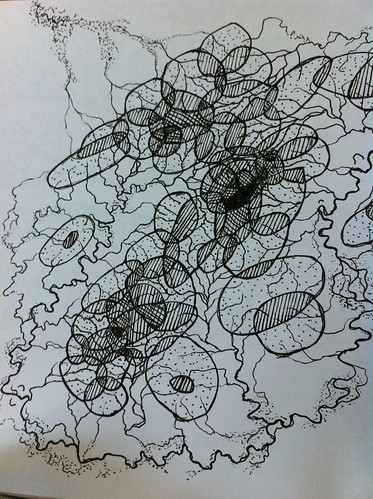
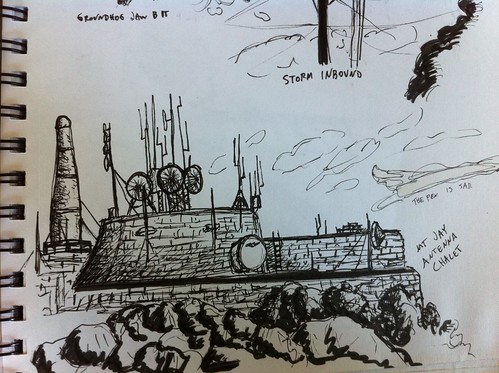
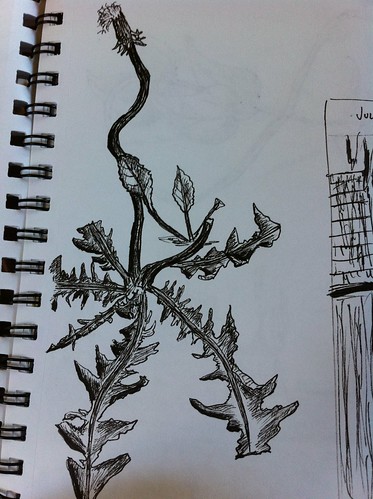
More here.
More here.
Wednesday, July 20, 2011
Vermont Summer Storms and Fickle Mountain Streams
The mountain streams and small rivers of Vermont are one of the state's treasures. These streams, which hold copious water all year, are a huge draw to people looking to fish, swim, wade, dive, and explore. These activities are an important part of the summer in Vermont and other areas with mountain streams, and by all means people should be enjoying these places. However, they need to do so with respect for the fact that these waterways change fast, and can be quite dangerous at times.
This month a tragedy struck at the Bolton Potholes when a 12 year old boy drowned. Another tragedy was narrowly averted when two people were rescued from Huntington Gorge. There are many factors that can lead to danger, including dangerous cliff diving, drunken exploits into dangerous waters, or just bad luck. One of the strongest factors, it seems, and one that is also often not well understood, is just how quickly these rivers and streams change during and after summer storms.
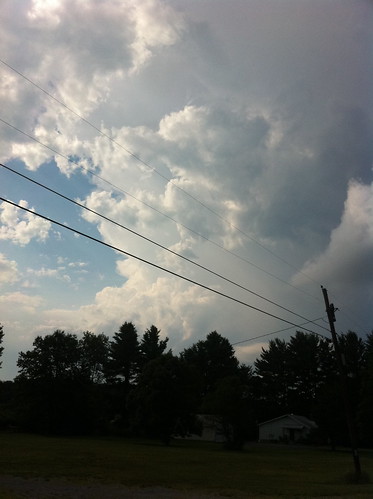
This month a tragedy struck at the Bolton Potholes when a 12 year old boy drowned. Another tragedy was narrowly averted when two people were rescued from Huntington Gorge. There are many factors that can lead to danger, including dangerous cliff diving, drunken exploits into dangerous waters, or just bad luck. One of the strongest factors, it seems, and one that is also often not well understood, is just how quickly these rivers and streams change during and after summer storms.
Saturday, July 16, 2011
iNaturalist - more tech-based citizen science
In my search for fun, useful citizen science projects that involve smartphones and location data, I somehow managed to miss iNaturalist until now. It's too bad, because this project seems to work a lot better than other ones I've tried out. Among other things:
- species are organized on a database that is hierarchical based on taxonomy, making it easy to search, make partial identifications, and obtain linked info.
- For some species, range maps are already present, and there are plans to upload more
- You have the option to control your geoprivacy, meaning you can upload location data that only you and the site admins can see.
- Projects are versatile and seem easy to set up (I haven't tried yet, though).
- The iPhone app and website are easy to use and not buggy.
- There are a lot of neat people on the website who will help ID organisms. In some cases, I've had IDs entered within minutes of an upload
- It is easy to save observations on the phone and upload them when you are in a WiFi area.
- It's fun!
So far, it doesn't appear that there is an easy way to track abiotic features of the natural world, such as weather events, urban hydrology, or geologic features. That may, in fact, be too off-topic for the website, but I hope someone creates one for those things someday.
If you're interested, try it out! You can see/follow my profile and sightings here.
Monday, July 11, 2011
July 6 Severe Thunderstorms near Burlington, Vermont
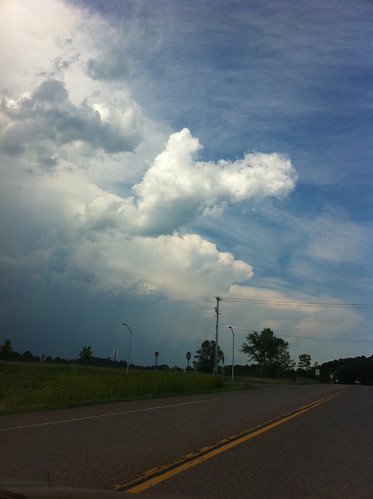
On July 6, another line of severe thunderstorms passed through Vermont, causing wind damage in many areas. I had the opportunity to get a very good view of these storms, because we ended up driving through the line in Charlotte, Vermont.
Wednesday, July 6, 2011
Slow Water in the Garden
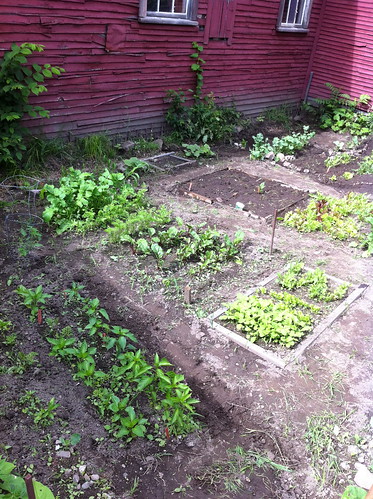
One of the neat things about water is how it is scalable - how water flowing over a small area acts similar to how it would at a much larger scale. I've been experiencing this in our garden this summer.
Tuesday, June 28, 2011
Eau Lente à Montréal, Québec (Slow Water in Montreal, Quebec)
(Note that I used Google Translator for the title, if it looks wrong, let me know and I'll fix it).
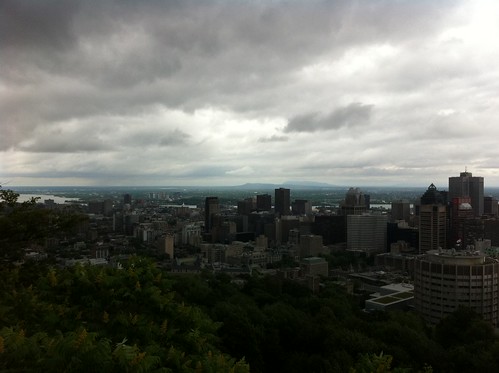
I've been spending quite a bit of time in Quebec lately. Last weekend I was in Montreal for the Jazz Fest, but of course I was looking around at urban water features as well.
Friday, June 24, 2011
Fun with QR Codes
It's been rainy and wet out, so after walking around in the rain a bit, I decided to come in and play around with some technology.
My friend just got back from New York City, and mentioned that the prevalence of QR codes has recently increased drastically. These codes, in the form of squares embedded with a variety of large pixels, can be used to encode URLs, text, and other information. They are most often used for marketing but are occasionally being used for outreach as well. The larger scale potential for use of QR codes is huge, although I think for the time being they will continue to mainly be used in marketing and advertising. I am thinking of putting up some QR codes for some of the urban hydrology features in Burlington after UVM fills with students again next fall, to see if anyone scans them.
I remembered reading somewhere that QR codes are not color sensitive. So, I decided to fiddle with the QR code a bit and see how much I could change it while retaining the link.
Here's the initial Slow Water Movement QR code:

I tried adding a bit of color... and it still worked.

Next, I tried moving a few of the pixels to create letters. Oddly, this still scans to the Slow Water Movement site:

Then I tried adding color to this version, including some subtle colors in the background:

I tried one more with more exaggerated colors, but it didn't work. This last one was the most modified one I was able to create that still linked to this blog.
Does it work on your phone? It may be that different phones have differing abilities to read QR codes. I have an Iphone 4.
Based on the wikipedia article I linked above, I am far from the first person to come up with this idea. Different forms of QR codes have been embedded in a wide variety of artistic endeavors.
Anyone else want to try making a fancy new Slow Water Movement QR code? Give it a try and if it works, I'll post it here too.
My friend just got back from New York City, and mentioned that the prevalence of QR codes has recently increased drastically. These codes, in the form of squares embedded with a variety of large pixels, can be used to encode URLs, text, and other information. They are most often used for marketing but are occasionally being used for outreach as well. The larger scale potential for use of QR codes is huge, although I think for the time being they will continue to mainly be used in marketing and advertising. I am thinking of putting up some QR codes for some of the urban hydrology features in Burlington after UVM fills with students again next fall, to see if anyone scans them.
I remembered reading somewhere that QR codes are not color sensitive. So, I decided to fiddle with the QR code a bit and see how much I could change it while retaining the link.
Here's the initial Slow Water Movement QR code:
I tried adding a bit of color... and it still worked.
Next, I tried moving a few of the pixels to create letters. Oddly, this still scans to the Slow Water Movement site:
Then I tried adding color to this version, including some subtle colors in the background:
I tried one more with more exaggerated colors, but it didn't work. This last one was the most modified one I was able to create that still linked to this blog.
Does it work on your phone? It may be that different phones have differing abilities to read QR codes. I have an Iphone 4.
Based on the wikipedia article I linked above, I am far from the first person to come up with this idea. Different forms of QR codes have been embedded in a wide variety of artistic endeavors.
Anyone else want to try making a fancy new Slow Water Movement QR code? Give it a try and if it works, I'll post it here too.
Thursday, June 23, 2011
Slow Water in Canada: Le Marais de la Rivière aux Cerise. (and adventures in northern Vermont)
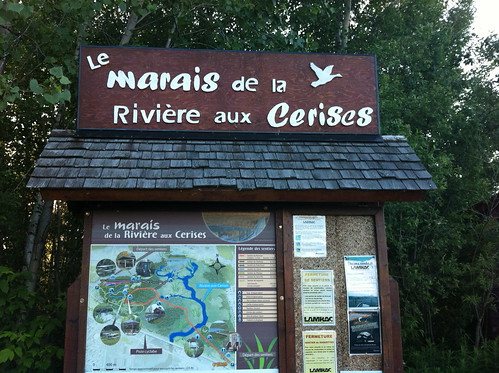
Last weekend we took a trip to Magog, Canada, at the north end of Lake Memphremagog. There we found a very neat wetland preserve: Le Marais de la Rivière aux Cerise (the Cherry River Marsh).
Subscribe to:
Posts (Atom)